












10 Sikh Gurus: The Pillars of Sikhism Who Shaped Faith, Equality, Courage, and Humanity
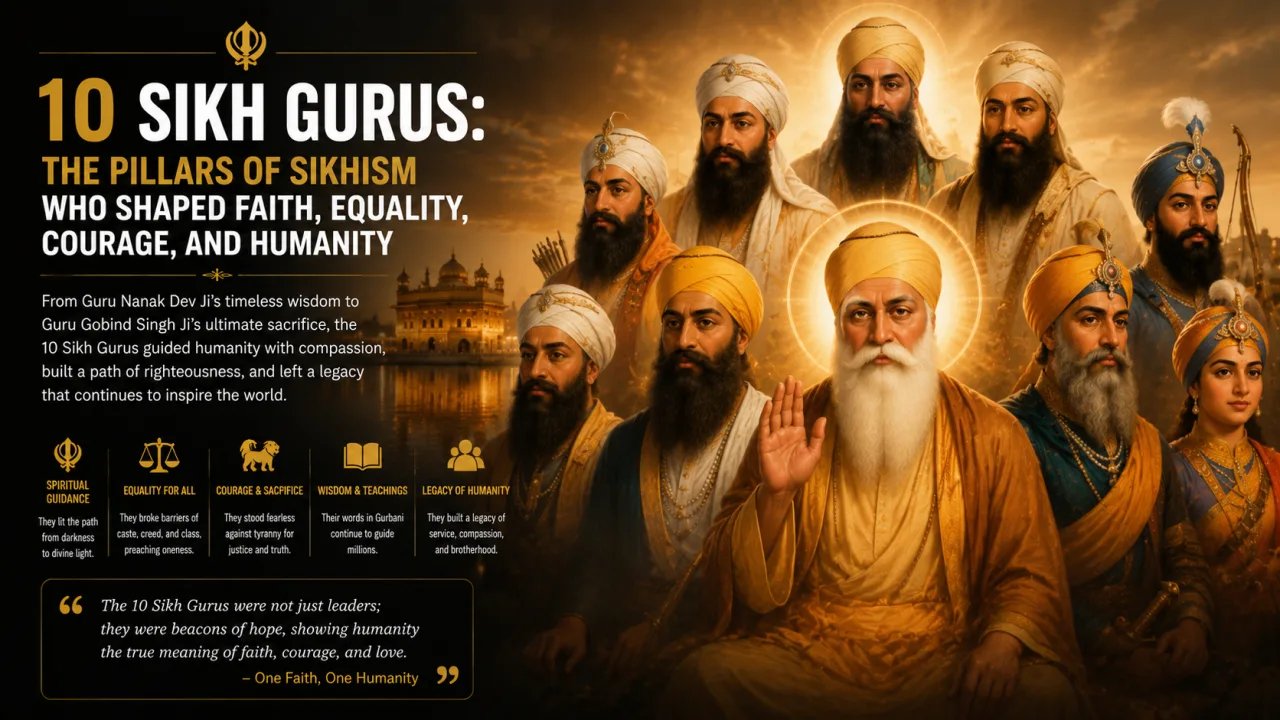
Introduction
Sikhism is one of the world's youngest major religions, yet its influence on spirituality, social justice, and human equality has been profound. Founded in the late fifteenth century in the Punjab region of the Indian subcontinent, Sikhism emerged during a period marked by political instability, religious divisions, social inequality, and rigid caste discrimination. Rather than promoting separation or conflict, Sikhism introduced a universal message centered on one God, equality of all human beings, honest living, selfless service, and devotion to truth.
Unlike many religious traditions that evolved around a single founder, Sikhism was shaped by a succession of '''Ten Gurus''' over a period of nearly 240 years. Each Guru inherited the same spiritual light while contributing uniquely to the growth of the Sikh community. Together, they transformed a small spiritual movement into a resilient faith founded on compassion, courage, discipline, and justice.
The Sikh Gurus were far more than religious teachers. They were philosophers, poets, educators, social reformers, community builders, military leaders, and defenders of human rights. Their lives demonstrate that spirituality is inseparable from ethical action and service to humanity.
Beginning with '''Guru Nanak Dev Ji''', who proclaimed the oneness of God (''Ik Onkar''), and culminating with '''Guru Gobind Singh Ji''', who established the Khalsa and declared the Guru Granth Sahib as the eternal Guru, the Ten Gurus collectively laid the foundation of Sikh beliefs, institutions, traditions, and identity.
Their teachings continue to guide millions of Sikhs worldwide and remain relevant in today's world, where values such as equality, religious freedom, compassion, and justice are more important than ever.
What Is Sikhism?
Sikhism is a monotheistic religion founded by '''Guru Nanak Dev Ji''' in 1469. The word '''Sikh''' comes from the Punjabi word ''Sikh'', meaning "disciple" or "learner." Followers of Sikhism strive to live according to divine wisdom while remaining active contributors to society.
At the heart of Sikhism are three fundamental principles taught by Guru Nanak:
- '''Naam Japna''' — Remembering and meditating on God.
- '''Kirat Karni''' — Earning an honest living through hard work.
- '''Vand Chakna''' — Sharing one's earnings and serving others.
These principles encourage spiritual growth while promoting responsibility toward family, community, and humanity.
Core Beliefs of Sikhism
The teachings of the Sikh Gurus are built upon several enduring principles:
- Belief in one universal God ( ''Ik Onkar'' ).
- Equality of all people regardless of caste, race, gender, or religion.
- Honest work and ethical living.
- Selfless service ( ''Seva'' ).
- Compassion and humility.
- Freedom of conscience and religion.
- Justice and protection of the oppressed.
- Rejection of superstition and empty rituals.
These values distinguish Sikhism as both a spiritual path and a practical way of life.
Timeline of the Ten Sikh Gurus
| Guru | Years as Guru | Major Contribution |
|---|---|---|
| Guru Nanak Dev Ji | 1469–1539 | Founded Sikhism and preached ''Ik Onkar'' |
| Guru Angad Dev Ji | 1539–1552 | Standardized the Gurmukhi script |
| Guru Amar Das Ji | 1552–1574 | Strengthened Langar and promoted equality |
| Guru Ram Das Ji | 1574–1581 | Founded Amritsar |
| Guru Arjan Dev Ji | 1581–1606 | Compiled the Adi Granth; first Sikh martyr |
| Guru Hargobind Sahib Ji | 1606–1644 | Introduced Miri-Piri and established the Akal Takht |
| Guru Har Rai Ji | 1644–1661 | Expanded Sikh missions and promoted compassion |
| Guru Har Krishan Ji | 1661–1664 | Served smallpox victims; remembered as the Child Guru |
| Guru Tegh Bahadur Ji | 1664–1675 | Martyred defending religious freedom |
| Guru Gobind Singh Ji | 1675–1708 | Founded the Khalsa and declared Guru Granth Sahib the eternal Guru |
1. Guru Nanak Dev Ji (1469–1539): Founder of Sikhism and Prophet of Universal Brotherhood
Overview
'''Guru Nanak Dev Ji''', the first Sikh Guru and founder of Sikhism, was born on '''15 April 1469''' in the village of '''Rai Bhoi di Talwandi''' (now '''Nankana Sahib''', Pakistan). He lived during a period of intense political upheaval, religious conflict, and social inequality in northern India.
His teachings challenged caste discrimination, religious intolerance, ritualism, and social injustice. Instead, he proclaimed that there is '''One Supreme Creator''' who is present in all people, making every human being equal regardless of birth, religion, occupation, or gender.
Guru Nanak's spiritual vision became the foundation of Sikhism and continues to inspire millions across the world.
Early Life
Guru Nanak was born to '''Mehta Kalu Chand (Kalyan Das Bedi)''' and '''Mata Tripta'''. His elder sister, '''Bibi Nanaki''', was among the first to recognize his extraordinary spiritual nature and remained one of his greatest supporters throughout his life.
From childhood, Guru Nanak displayed exceptional curiosity and compassion. Rather than accepting religious customs unquestioningly, he asked profound questions about the purpose of life, the nature of God, and the meaning of true devotion.
Traditional accounts describe several incidents that reflected his spiritual insight, including his reluctance to participate in rituals he believed lacked genuine understanding.
Spiritual Awakening
One of the defining moments in Guru Nanak's life occurred around the age of thirty. According to Sikh tradition, after disappearing while bathing in the Kali Bein River for three days, he emerged transformed by a profound spiritual experience.
He declared:
'''"There is no Hindu, there is no Muslim."'''
This statement did not reject either faith. Instead, it emphasized that sincere devotion to God transcends religious labels and that all people are equal before the Divine.
Soon afterward, Guru Nanak devoted his life to spreading this universal message.
The Four Udasis (Missionary Journeys)
Guru Nanak undertook four extensive missionary journeys, known as the '''Udasis''', traveling thousands of kilometers across South Asia, Tibet, Sri Lanka, the Arabian Peninsula, and Central Asia.
During these travels, he met scholars, ascetics, rulers, merchants, and ordinary people from diverse backgrounds. Rather than engaging in confrontation, he encouraged dialogue and mutual understanding.
His travels spread the core principles of Sikhism:
- One universal Creator.
- Honest living.
- Compassion for all.
- Equality.
- Rejection of superstition.
- Service to humanity.
Major Teachings
Guru Nanak's philosophy can be summarized through several enduring principles:
Ik Onkar
There is one eternal, formless God who is the Creator of all existence.
Naam Japna
Remember God continually through meditation, prayer, and righteous living.
Kirat Karni
Earn an honest livelihood through ethical work.
Vand Chakna
Share one's wealth, food, and resources with those in need.
Equality
Guru Nanak rejected caste distinctions and declared that all people possess equal spiritual dignity.
Service (Seva)
Selfless service to others is considered one of the highest forms of worship.
Establishment of Langar
One of Guru Nanak's most revolutionary contributions was the institution of '''Langar''', the free community kitchen.
In Langar:
- Everyone sits together.
- No distinction is made based on caste, religion, wealth, or gender.
- Meals are prepared and served by volunteers.
- The emphasis is on equality, humility, and service.
Langar remains one of the defining institutions of Sikhism and serves millions of people around the world each year.
Kartarpur
Guru Nanak eventually established the settlement of '''Kartarpur''', where he created a community centered on prayer, honest work, and shared meals. Kartarpur became a model for Sikh communal life and demonstrated how spiritual teachings could be integrated into everyday living.
Legacy
Before his passing in 1539, Guru Nanak appointed '''Bhai Lehna''' as his successor, renaming him '''Guru Angad Dev Ji'''. This decision emphasized that spiritual leadership should be based on merit, humility, and devotion rather than hereditary succession.
Guru Nanak's hymns now form a substantial portion of the '''Guru Granth Sahib''', the Sikh holy scripture. His teachings remain the cornerstone of Sikh philosophy and continue to inspire people of all backgrounds.
Quick Facts
| Category | Information |
|---|---|
| Born | 15 April 1469 |
| Birthplace | Nankana Sahib (present-day Pakistan) |
| Parents | Mehta Kalu Chand and Mata Tripta |
| Sister | Bibi Nanaki |
| Successor | Guru Angad Dev Ji |
| Major Contributions | Founded Sikhism, established Langar, preached ''Ik Onkar'' |
| Legacy | Founder of the Sikh faith and author of foundational hymns |
2. Guru Angad Dev Ji (1504–1552): The Guardian of Sikh Scripture and the Creator of the Gurmukhi Script
Overview
'''Guru Angad Dev Ji''', the second Sikh Guru, played a vital role in preserving and strengthening the foundations laid by Guru Nanak Dev Ji. While Guru Nanak established the spiritual philosophy of Sikhism, Guru Angad transformed those teachings into an organized and enduring community by standardizing the Punjabi language through the '''Gurmukhi script''', promoting education, physical fitness, and expanding the institution of '''Langar'''.
Originally named '''Bhai Lehna''', Guru Angad Dev Ji was born on '''31 March 1504''' in the village of '''Matte di Sarai''', now known as '''Sarai Naga''', in present-day Punjab, India. Before becoming Guru, he was a devoted worshipper of the Hindu goddess Durga and regularly led annual pilgrimages to her temple.
His life changed dramatically after meeting Guru Nanak Dev Ji. Deeply moved by Guru Nanak's message of equality, humility, and devotion to one God, Bhai Lehna became one of his most devoted disciples. His humility, unwavering faith, and complete selflessness eventually led Guru Nanak to appoint him as his spiritual successor.
Guru Angad's leadership ensured that Sikhism evolved from a small spiritual movement into an organized and growing religious community capable of preserving its teachings for future generations.
Quick Facts
| Category | Information |
|---|---|
| Birth Name | Bhai Lehna |
| Born | 31 March 1504 |
| Birthplace | Matte di Sarai (Sarai Naga), Punjab |
| Parents | Bhai Pheru Mal and Mata Daya Kaur |
| Guru Period | 1539–1552 |
| Successor | Guru Amar Das Ji |
| Major Contributions | Gurmukhi Script, Education, Langar Expansion |
| Passed Away | 29 March 1552 |
Early Life
Guru Angad Dev Ji was born into a Hindu Khatri family. His father, '''Bhai Pheru Mal''', was a merchant, while his mother, '''Mata Daya Kaur''', raised him with strong moral values and religious devotion.
As a young man, Bhai Lehna became an ardent devotee of Goddess Durga. Every year, he organized groups of pilgrims traveling to the famous shrine at Jawalamukhi in the Himalayan foothills. His leadership qualities and deep spirituality earned him great respect within his community.
Despite his devotion, Bhai Lehna felt that something was missing. He sought a deeper understanding of God—one that transcended rituals and ceremonies.
Meeting Guru Nanak Dev Ji
One day, Bhai Lehna heard a Sikh devotee singing hymns composed by Guru Nanak Dev Ji. The profound spiritual message contained within the hymns deeply touched him.
Determined to meet their author, he traveled to Kartarpur.
The meeting transformed his life forever.
Guru Nanak's teachings about:
- One universal God
- Equality among all people
- Honest work
- Humility
- Selfless service
answered the spiritual questions Bhai Lehna had carried for years.
He immediately chose to remain with Guru Nanak and became one of his closest disciples.
A Model of Humility
Numerous Sikh traditions describe Bhai Lehna's extraordinary humility.
Unlike many disciples seeking recognition, he willingly performed even the simplest tasks without complaint.
Stories describe him:
- carrying heavy loads,
- cleaning muddy paths,
- serving visitors,
- working in the Langar,
- and placing the Guru's needs before his own.
Guru Nanak often tested his followers—not to embarrass them, but to reveal their sincerity.
Time after time, Bhai Lehna demonstrated complete faith and obedience.
Because of this, Guru Nanak renamed him '''Angad''', meaning '''"part of my own body."'''
The name symbolized that the same divine light now continued through Guru Angad.
Becoming the Second Sikh Guru
Before passing away in 1539, Guru Nanak surprised many by choosing Bhai Lehna instead of one of his own sons as the next Guru.
This decision established one of the most important principles in Sikhism:
'''Spiritual leadership is earned through humility, wisdom, and service—not inherited through family lineage.'''
Guru Angad accepted the responsibility with great humility and continued Guru Nanak's mission without altering its central teachings.
Development of the Gurmukhi Script
One of Guru Angad Dev Ji's greatest contributions was the development and standardization of the '''Gurmukhi script'''.
Although forms of the script already existed in Punjab, Guru Angad refined, organized, and standardized it.
This achievement had enormous historical importance.
Why was Gurmukhi important?
Before Gurmukhi became standardized:
- Punjabi had no universally accepted writing system.
- Religious teachings were often transmitted orally.
- Literacy among ordinary people was limited.
Guru Angad recognized that preserving Guru Nanak's teachings required a reliable written language.
He therefore:
- standardized the alphabet,
- simplified writing,
- encouraged literacy,
- taught reading and writing to children,
- made education accessible to ordinary people.
Today, Gurmukhi remains the primary script used to write Punjabi and the sacred Sikh scriptures.
Without Guru Angad's work, much of Sikh literature may never have been preserved.
Promotion of Education
Guru Angad believed that education should be available to everyone—not only priests or scholars.
He established schools where children learned:
- reading,
- writing,
- ethics,
- spirituality,
- practical life skills.
Unlike many educational systems of the period, these schools welcomed people regardless of caste or social status.
Education became a powerful tool for social equality.
Strengthening the Langar
Guru Nanak established the Langar tradition.
Guru Angad expanded it considerably.
Every visitor, regardless of background, was expected to sit together and eat from the same kitchen.
This practice directly challenged India's deeply rooted caste system.
Rich and poor...
Kings and laborers...
Men and women...
All shared the same meal.
Langar became one of Sikhism's most visible expressions of equality.
Encouraging Physical Fitness
Guru Angad believed spiritual growth should be accompanied by physical health.
He established '''Mal Akharas''' (traditional wrestling schools).
Young Sikhs were encouraged to:
- exercise,
- wrestle,
- maintain good health,
- develop discipline,
- cultivate courage.
This balanced approach prepared Sikhs for both spiritual devotion and practical life.
Preserving Guru Nanak's Hymns
Guru Angad carefully collected and preserved Guru Nanak's hymns.
His efforts later enabled Guru Arjan Dev Ji to compile the '''Adi Granth''', the first edition of Sikh scripture.
Without Guru Angad's careful preservation of these writings, many compositions could have been lost.
Leadership Style
Guru Angad led through personal example rather than authority.
His leadership emphasized:
- Humility
- Discipline
- Simplicity
- Education
- Equality
- Honest labor
- Service to humanity
He avoided political power and instead focused on building a spiritually strong community.
Important Contributions
Guru Angad's contributions include:
- Standardized the Gurmukhi alphabet.
- Expanded Sikh education.
- Strengthened the Langar institution.
- Preserved Guru Nanak's teachings.
- Encouraged physical fitness.
- Promoted literacy among ordinary people.
- Strengthened Sikh identity.
- Expanded the Sikh community.
Interesting Facts
- Guru Angad was 35 years old when he became Guru.
- His original name was Bhai Lehna.
- "Angad" means "part of my own body."
- He rejected hereditary succession despite pressure from Guru Nanak's family.
- Gurmukhi remains the official script of Sikh scripture today.
- His educational reforms dramatically increased literacy among early Sikhs.
Legacy
Guru Angad Dev Ji served as Guru for approximately thirteen years.
Although his tenure was relatively short, his influence on Sikh history was immense.
He transformed Guru Nanak's growing spiritual movement into a more organized religious community by preserving its teachings, standardizing its language, and promoting education for all.
Perhaps his greatest legacy was ensuring that Sikhism would have a permanent written foundation. The Gurmukhi script not only preserved the hymns of the Gurus but also became a powerful symbol of Sikh identity and Punjabi culture.
Before his passing in 1552, Guru Angad appointed '''Guru Amar Das Ji''' as the third Sikh Guru, once again demonstrating that humility, devotion, and service—not birthright—were the qualifications for spiritual leadership.
Summary
Guru Angad Dev Ji is remembered as the architect of Sikh education and literacy. Through his development of the Gurmukhi script, expansion of the Langar tradition, encouragement of physical fitness, and preservation of Guru Nanak's teachings, he laid the institutional foundations upon which Sikhism would continue to flourish.
His life exemplifies the Sikh ideals of humility, discipline, and selfless service, ensuring that the message of Guru Nanak would endure for generations.
Chapter 3: Guru Amar Das Ji (1479–1574) — Champion of Equality, Women's Rights, and Social Reform
Overview
'''Guru Amar Das Ji''', the third Sikh Guru, is remembered as one of the greatest social reformers in Sikh history. During his twenty-two years as Guru, he transformed Sikhism from a growing spiritual movement into a well-organized religious community founded upon equality, humility, service, and justice. He vigorously opposed the caste system, challenged discriminatory customs against women, strengthened the institution of '''Langar''', introduced an efficient missionary administration through the '''Manji System''', and expanded the reach of Guru Nanak's teachings throughout northern India.
Born on '''5 May 1479''' in the village of '''Basarke''', near present-day Amritsar in Punjab, Guru Amar Das Ji did not become the Sikh Guru until the remarkable age of seventy-three. His life demonstrates that spiritual awakening is not limited by age and that unwavering devotion, humility, and selfless service are the true qualifications for leadership.
Unlike many influential religious leaders who inherited authority through family lineage, Guru Amar Das Ji earned the Guruship through decades of dedicated service to Guru Angad Dev Ji. His leadership reflected the Sikh ideals of compassion, discipline, equality, and devotion to God, leaving an enduring legacy that continues to shape Sikh institutions today.
Quick Facts
| Category | Information |
|---|---|
| Birth Name | Amar Das Bhalla |
| Born | 5 May 1479 |
| Birthplace | Basarke, Punjab |
| Parents | Tej Bhan Bhalla and Mata Sulakhni |
| Guru Period | 1552–1574 |
| Successor | Guru Ram Das Ji |
| Major Contributions | Manji System, Women's Rights, Langar Expansion, Baoli at Goindwal |
| Passed Away | 1 September 1574 |
Early Life
Guru Amar Das Ji was born into a devout Hindu Khatri family. His father, '''Tej Bhan Bhalla''', was a respected farmer and merchant, while his mother, '''Mata Sulakhni''', instilled strong moral and religious values in him from an early age.
As a young man, Amar Das Ji faithfully observed Hindu traditions and regularly undertook pilgrimages to sacred sites, particularly Haridwar. Despite his deep religious commitment, he felt spiritually unfulfilled. Years of ritual observance did not provide the inner peace and direct connection with God that he sought.
For decades, he continued searching for spiritual truth.
Meeting Guru Angad Dev Ji
The turning point in Amar Das Ji's life came unexpectedly.
One morning, he heard '''Bibi Amro''', the daughter of Guru Angad Dev Ji, singing hymns composed by Guru Nanak Dev Ji. The profound message of these hymns deeply moved him. He immediately asked about their origin and soon traveled to Khadur Sahib to meet Guru Angad.
That meeting transformed his life.
At the age of sixty-two, Amar Das Ji became a devoted disciple of Guru Angad Dev Ji.
Years of Humble Service
For more than a decade, Amar Das Ji served Guru Angad with extraordinary humility.
Sikh tradition recounts that every morning before dawn, regardless of the weather, he walked several kilometers to the Beas River to fetch fresh water for Guru Angad's bath. He also performed countless acts of service, including preparing meals, cleaning the community kitchen, welcoming visitors, and assisting anyone in need.
He never sought recognition or status. His devotion reflected the Sikh principle of '''Seva'''—selfless service performed without expectation of reward.
His humility and unwavering commitment eventually led Guru Angad Dev Ji to appoint him as the third Sikh Guru in 1552.
Becoming the Third Sikh Guru
Guru Amar Das Ji assumed the Guruship at the age of seventy-three, proving that spiritual leadership depends on character rather than age or social position.
His appointment reinforced a key Sikh principle: leadership should be based on merit, humility, and dedication—not heredity.
Despite opposition from some members of Guru Angad's family, Guru Amar Das Ji focused entirely on expanding the Sikh community and strengthening its institutions.
Champion of Equality
One of Guru Amar Das Ji's defining achievements was his unwavering commitment to human equality.
Sixteenth-century Indian society was deeply divided by caste, gender discrimination, and social hierarchy. Guru Amar Das rejected these distinctions completely, teaching that all human beings are equal before God.
He insisted that every visitor—whether a farmer, merchant, noble, or emperor—must first sit together in the '''Langar''' before meeting the Guru. This practice became known as '''"Pehle Pangat, Phir Sangat"''' ("First sit together in the communal meal, then join the congregation").
The Langar was not merely a meal; it was a powerful declaration that caste and social status had no place within the Sikh community.
Advocate for Women's Rights
Guru Amar Das Ji was centuries ahead of his time in advocating for the dignity and equality of women.
He openly opposed several harmful social customs, including:
- '''Sati''' , the practice of widows being forced or pressured to immolate themselves on their husbands' funeral pyres.
- '''Purdah''' , which restricted women's participation in public life.
- Gender discrimination in religious leadership.
Guru Amar Das Ji taught that women possessed the same spiritual potential as men. He encouraged their active participation in religious gatherings and appointed women to leadership positions within the Sikh community.
His reforms represented one of the earliest organized movements for women's empowerment in South Asia.
The Manji System
As the Sikh community expanded, Guru Amar Das Ji recognized the need for a structured administrative system.
He introduced the '''Manji System''', dividing the growing Sikh congregation into regional districts known as ''Manjis''. Each district was led by a trusted representative responsible for teaching Sikh principles, organizing congregations, and maintaining community welfare.
Remarkably, several of these leaders were women—a revolutionary decision in the sixteenth century.
The Manji System enabled Sikhism to spread efficiently while maintaining unity and consistency in teaching.
The Baoli at Goindwal
Guru Amar Das Ji established '''Goindwal Sahib''' as an important center of Sikh learning and pilgrimage.
There he supervised the construction of a remarkable '''Baoli''' (stepwell) consisting of '''84 steps'''. Pilgrims descended the steps while meditating on God's name, symbolizing the spiritual journey toward liberation.
Unlike many contemporary pilgrimage sites, the Baoli at Goindwal emphasized devotion and remembrance of God rather than ritualistic practices.
Goindwal soon became one of the earliest major Sikh pilgrimage centers.
Strengthening the Langar
Guru Amar Das Ji greatly expanded the institution of Langar.
The community kitchen became a permanent feature of Sikh religious life, serving everyone regardless of caste, religion, wealth, or occupation.
Even '''Emperor Akbar''', one of the Mughal Empire's most powerful rulers, is said to have sat among ordinary people in the Langar before meeting Guru Amar Das Ji—a profound demonstration of Sikh ideals of equality.
Literary Contributions
Guru Amar Das Ji composed numerous hymns that were later included in the '''Guru Granth Sahib'''.
His writings focus on themes such as:
- Devotion to one God
- Humility
- Equality
- Selfless service
- Spiritual discipline
- Rejection of empty rituals
- The importance of the Guru
These hymns continue to be recited daily by Sikhs around the world.
Important Contributions
Guru Amar Das Ji's lasting contributions include:
- Expanded the Langar institution.
- Introduced the Manji administrative system.
- Promoted literacy and religious education.
- Opposed the caste system.
- Campaigned against Sati.
- Rejected Purdah.
- Appointed women to leadership roles.
- Established Goindwal Sahib.
- Built the Baoli with 84 steps.
- Strengthened Sikh missionary work.
Interesting Facts
- Guru Amar Das Ji became Guru at the age of '''73''' , making him the oldest person to assume the Guruship.
- He served Guru Angad Dev Ji for approximately '''twelve years''' before becoming Guru.
- He institutionalized the principle that everyone must eat together before meeting the Guru.
- Emperor Akbar reportedly visited him and participated in Langar.
- Many of his hymns remain part of daily Sikh prayers.
Legacy
Guru Amar Das Ji transformed Sikhism into a well-organized and socially progressive community. His reforms challenged entrenched inequalities and established institutions that continue to define Sikh practice today.
His emphasis on equality, women's rights, and organized community service laid the groundwork for future Gurus to expand the faith. Through the Manji System, the strengthening of Langar, and the promotion of inclusive leadership, he ensured that Sikhism remained accessible to people of every background.
Before his passing in 1574, Guru Amar Das Ji appointed his devoted son-in-law '''Guru Ram Das Ji''' as the fourth Sikh Guru, once again demonstrating that spiritual leadership should be based on merit, humility, and service.
Summary
Guru Amar Das Ji is remembered as one of Sikhism's greatest social reformers. His courageous opposition to caste discrimination and gender inequality, combined with his organizational vision, transformed the Sikh community into a dynamic and inclusive religious movement.
His life teaches that true spirituality is expressed not only through devotion to God but also through compassion, justice, equality, and selfless service to humanity.
Chapter 4: Guru Ram Das Ji (1534–1581) — Founder of Amritsar and Architect of Sikh Institutions
Overview
'''Guru Ram Das Ji''', the fourth Sikh Guru, occupies a unique place in Sikh history as the visionary who transformed the growing Sikh community into a thriving spiritual and cultural center. During his leadership from '''1574 to 1581''', he founded the city of '''Amritsar''', initiated the excavation of the sacred pool that would later surround the '''Harmandir Sahib (Golden Temple)''', strengthened Sikh institutions, expanded missionary activities, and composed devotional hymns that continue to guide Sikh religious life.
Born as '''Bhai Jetha''' on '''24 September 1534''' in '''Chuna Mandi, Lahore''' (present-day Pakistan), Guru Ram Das Ji came from humble beginnings. Orphaned at an early age, he earned a living by selling boiled chickpeas in the local markets before eventually meeting Guru Amar Das Ji. His humility, tireless service, and unwavering devotion led Guru Amar Das Ji to appoint him as the fourth Sikh Guru, reinforcing the Sikh principle that leadership is earned through merit and selfless service rather than inherited by birth.
Although his tenure lasted only seven years, Guru Ram Das Ji left an extraordinary legacy that permanently shaped Sikh identity. His establishment of Amritsar laid the foundation for what would become the spiritual heart of Sikhism, while his hymns, institutions, and organizational reforms strengthened the faith for future generations.
Quick Facts
| Category | Information |
|---|---|
| Birth Name | Bhai Jetha |
| Born | 24 September 1534 |
| Birthplace | Lahore (present-day Pakistan) |
| Parents | Hari Das Sodhi and Mata Daya Kaur |
| Guru Period | 1574–1581 |
| Successor | Guru Arjan Dev Ji |
| Major Contributions | Founded Amritsar, Expanded Sikh Institutions, Composed Lavaan Hymns |
| Passed Away | 1 September 1581 |
Early Life
Guru Ram Das Ji was born into the '''Sodhi Khatri''' family in Lahore. His father, '''Hari Das Sodhi''', and mother, '''Mata Daya Kaur''', passed away while he was still very young, leaving him an orphan.
Raised by his grandmother, the young Bhai Jetha experienced poverty firsthand. To support himself, he sold boiled chickpeas (''chane'') in the streets of Lahore. Despite these hardships, he remained cheerful, honest, and deeply spiritual.
His difficult childhood cultivated qualities that would define his leadership throughout life—humility, perseverance, generosity, and compassion for those less fortunate.
Meeting Guru Amar Das Ji
As a young man, Bhai Jetha traveled to '''Goindwal''', where he encountered Guru Amar Das Ji and the flourishing Sikh community.
He was deeply impressed by the Guru's teachings, especially the emphasis on:
- Equality
- Honest work
- Selfless service (Seva)
- Devotion to one God
- Community welfare
Rather than seeking recognition, Bhai Jetha devoted himself entirely to serving the Guru and the Sangat (congregation). He participated in the Langar, helped construct buildings, welcomed visitors, and carried out even the simplest tasks with joy.
Guru Amar Das Ji recognized these qualities and eventually arranged Bhai Jetha's marriage to his younger daughter, '''Bibi Bhani''', a devoted Sikh who herself became an important figure in Sikh history.
Appointment as the Fourth Guru
When Guru Amar Das Ji approached the end of his earthly life, he selected Bhai Jetha as his successor and bestowed upon him the name '''Guru Ram Das''', meaning '''"Servant of God."'''
The appointment once again demonstrated that spiritual authority in Sikhism was based on devotion, humility, and service—not hereditary privilege.
Guru Ram Das Ji assumed the Guruship in '''1574''', continuing the mission of his predecessors while guiding the Sikh community into a new phase of growth.
Founding of Amritsar
Guru Ram Das Ji's most enduring achievement was the establishment of the city of '''Amritsar''', today the holiest city in Sikhism.
Recognizing the need for a permanent spiritual and administrative center, Guru Ram Das Ji acquired land with the support of Emperor Akbar and began developing a new settlement originally known as '''Guru Ka Chak''', later called '''Ramdaspur'''.
He encouraged merchants, artisans, farmers, and families to settle in the new town, creating a thriving community centered on faith, honest labor, and mutual cooperation.
Over time, Ramdaspur evolved into '''Amritsar''', one of India's most significant religious and cultural cities.
Excavation of the Sacred Pool
Guru Ram Das Ji also initiated the excavation of a large sacred water reservoir, known as the '''Amrit Sarovar''' ("Pool of Nectar").
This pool became the defining feature of the new city.
Its construction symbolized:
- spiritual purification,
- humility,
- equality,
- and the gathering of the Sikh community around a common center of worship.
Although Guru Ram Das Ji did not live to see the completion of the project, his son and successor, '''Guru Arjan Dev Ji''', completed the pool and later constructed the '''Harmandir Sahib''' at its center.
Today, millions of pilgrims visit this sacred site every year.
Expansion of the Sikh Community
Guru Ram Das Ji continued expanding the missionary work begun by Guru Amar Das Ji.
He strengthened the '''Masand System''', appointing trusted representatives to:
- teach Sikh philosophy,
- collect voluntary offerings,
- organize congregations,
- support community projects,
- maintain communication with the Guru.
This organizational structure enabled Sikhism to grow rapidly across Punjab and neighboring regions while maintaining unity among dispersed congregations.
Literary Contributions
Guru Ram Das Ji was an accomplished poet and spiritual teacher.
He composed approximately '''679 hymns''', all of which are included in the '''Guru Granth Sahib'''.
His compositions emphasize:
- humility,
- devotion,
- love of God,
- inner peace,
- spiritual discipline,
- gratitude,
- and the importance of the Guru.
These hymns remain central to Sikh worship today.
The Lavaan Hymns and Sikh Marriage
One of Guru Ram Das Ji's most influential contributions was the composition of the '''Lavaan''', the four sacred hymns recited during the Sikh marriage ceremony, known as the '''Anand Karaj'''.
Unlike marriages based solely on social customs, the Lavaan describe marriage as a spiritual partnership in which husband and wife journey together toward union with God.
Each of the four hymns represents a stage of spiritual growth:
- Commitment to righteous living.
- Deepening devotion.
- Growing love for the Divine.
- Complete spiritual union with God.
Today, every Sikh marriage ceremony centers around these sacred hymns.
Relationship with Emperor Akbar
Guru Ram Das Ji maintained cordial relations with '''Mughal Emperor Akbar''', who was known for his policy of relative religious tolerance.
Historical accounts suggest that Akbar respected the Sikh Gurus and appreciated their commitment to equality and community service.
The peaceful relationship during Guru Ram Das Ji's lifetime allowed the Sikh community to expand without significant political interference.
Leadership Philosophy
Guru Ram Das Ji believed that spiritual leadership required:
- Humility before God.
- Compassion toward humanity.
- Honest labor.
- Continuous service.
- Equality among all people.
- Community development.
Rather than seeking political power, he focused on building institutions that strengthened both the spiritual and practical lives of Sikhs.
Major Contributions
Guru Ram Das Ji's enduring contributions include:
- Founded the city of '''Amritsar''' .
- Began excavation of the '''Amrit Sarovar''' .
- Expanded the '''Masand System''' .
- Strengthened Sikh missionary work.
- Composed the '''Lavaan''' marriage hymns.
- Authored hundreds of hymns preserved in the Guru Granth Sahib.
- Encouraged economic development around Sikh institutions.
- Strengthened community organization.
Interesting Facts
- Guru Ram Das Ji was originally known as '''Bhai Jetha''' .
- He experienced poverty during childhood.
- He personally participated in community service despite becoming Guru.
- He composed the hymns used in every Sikh wedding ceremony.
- The city he founded eventually became home to the Golden Temple.
- More than 600 of his hymns are preserved in Sikh scripture.
Legacy
Although Guru Ram Das Ji served as Guru for only seven years, his vision permanently transformed Sikhism.
The city of Amritsar became the spiritual capital of the Sikh faith, while the Amrit Sarovar laid the foundation for the construction of the Harmandir Sahib. His organizational reforms strengthened the expanding Sikh community, and his devotional hymns enriched Sikh worship for generations.
Perhaps his greatest achievement was creating a physical and spiritual center where Sikhs from every background could gather in equality and devotion.
Before his passing in 1581, Guru Ram Das Ji appointed his youngest son, '''Guru Arjan Dev Ji''', as the fifth Sikh Guru, ensuring the continuation of the Guruship through wisdom, service, and spiritual merit.
Summary
Guru Ram Das Ji transformed Sikhism from a regional movement into a well-organized and enduring religious community. Through the founding of Amritsar, the creation of the Amrit Sarovar, the composition of the Lavaan hymns, and the strengthening of Sikh institutions, he established foundations that continue to shape Sikh identity today.
His life remains a powerful example of humility, service, visionary leadership, and devotion to God.
Chapter 5: Guru Arjan Dev Ji (1563–1606) — Compiler of the Adi Granth, Builder of the Harmandir Sahib, and the First Sikh Martyr
Overview
'''Guru Arjan Dev Ji''', the fifth Sikh Guru, is one of the most influential figures in Sikh history. His leadership marked a transformative period during which Sikhism evolved from a growing religious movement into a well-organized spiritual community with a sacred scripture, a central place of worship, and a distinct religious identity.
Guru Arjan Dev Ji is revered for compiling the '''Adi Granth''', the first authorized Sikh scripture, completing the construction of the '''Harmandir Sahib (Golden Temple)''' at Amritsar, expanding Sikh institutions, and becoming the '''first Sikh martyr''' after sacrificing his life in defense of religious freedom and spiritual principles.
His martyrdom in '''1606''', under the Mughal Emperor '''Jahangir''', profoundly changed the course of Sikh history. It inspired the Sikh community to combine spiritual devotion with the courage to defend justice, a philosophy that would later be strengthened by Guru Hargobind Sahib Ji and Guru Gobind Singh Ji.
Today, Guru Arjan Dev Ji is remembered as a saint, scholar, poet, visionary, architect, and martyr whose contributions continue to define Sikhism.
Quick Facts
| Category | Information |
|---|---|
| Birth Name | Arjan Mal |
| Born | 15 April 1563 |
| Birthplace | Goindwal, Punjab |
| Parents | Guru Ram Das Ji and Mata Bhani |
| Guru Period | 1581–1606 |
| Successor | Guru Hargobind Sahib Ji |
| Major Contributions | Compiled Adi Granth, Completed Harmandir Sahib, Expanded Amritsar |
| Martyred | 30 May 1606 (traditional Sikh dating; commonly commemorated in June) |
Early Life
Guru Arjan Dev Ji was born on '''15 April 1563''' in '''Goindwal''', the important Sikh center established during the time of Guru Amar Das Ji.
He was the youngest son of '''Guru Ram Das Ji''' and '''Mata Bhani''', who was herself the daughter of Guru Amar Das Ji. From an early age, Arjan displayed remarkable intelligence, humility, and devotion.
Growing up in a deeply spiritual household, he received instruction in:
- Sikh philosophy
- Punjabi and Gurmukhi
- Poetry
- Music
- Community service (Seva)
- Meditation on God's Name (Naam Simran)
His gentle temperament, wisdom, and compassion distinguished him from an early age.
Becoming the Fifth Sikh Guru
When Guru Ram Das Ji approached the end of his earthly life, he chose Arjan Dev Ji as his successor in '''1581'''.
The decision was based not on birth order but on Arjan's spiritual maturity, humility, and dedication.
As with previous Gurus, the succession reinforced a fundamental Sikh principle:
'''Leadership belongs to those who embody spiritual wisdom, humility, and selfless service—not merely to those born into a particular family line.'''
Guru Arjan Dev Ji assumed leadership during a period of rapid expansion of the Sikh community.
Completion of Amritsar
Guru Arjan Dev Ji continued the work begun by his father, Guru Ram Das Ji, in developing the city of '''Amritsar'''.
Under his leadership, the city became:
- the spiritual center of Sikhism,
- a thriving commercial town,
- an important center of learning,
- and a gathering place for Sikhs from across the Indian subcontinent.
He encouraged merchants, farmers, artisans, and travelers to settle there, helping transform Amritsar into one of the most prosperous cities in Punjab.
Construction of the Harmandir Sahib (Golden Temple)
Perhaps Guru Arjan Dev Ji's greatest architectural achievement was completing the '''Harmandir Sahib''', today known worldwide as the '''Golden Temple'''.
Unlike many religious buildings of the period, Harmandir Sahib reflected Sikh values through its unique design.
Four Entrances
The temple was built with '''four entrances''', symbolizing that people from every direction, religion, caste, nationality, and social background were welcome.
This architectural choice expressed Guru Arjan's belief that God's grace is open to all humanity.
Lower Than the Surrounding Land
The Harmandir Sahib was deliberately built at a lower level than the surrounding land.
Visitors descend steps before entering, symbolizing that humility is essential on the spiritual path.
Central Location
Situated in the middle of the '''Amrit Sarovar''', the shrine is connected by a causeway that represents the spiritual journey from worldly life toward divine realization.
Compilation of the Adi Granth
Guru Arjan Dev Ji's most enduring contribution was the compilation of the '''Adi Granth''' in '''1604'''.
Before its compilation, the hymns of the Gurus were preserved in separate collections and through oral tradition.
Guru Arjan recognized that a single, authentic scripture was necessary to preserve the integrity of Sikh teachings and prevent the spread of inaccurate versions.
Contents of the Adi Granth
The Adi Granth included:
- Hymns of Guru Nanak Dev Ji
- Guru Angad Dev Ji
- Guru Amar Das Ji
- Guru Ram Das Ji
- Guru Arjan Dev Ji
It also included compositions by respected saints from different religious and social backgrounds, including:
- Kabir
- Ravidas
- Sheikh Farid
- Namdev
- Trilochan
- Dhanna
- Pipa
- Ramanand
- Beni
- Jaidev
The inclusion of these voices demonstrated Sikhism's universal outlook and respect for spiritual truth wherever it is found.
Bhai Gurdas as Scribe
Guru Arjan entrusted '''Bhai Gurdas''', one of Sikhism's greatest scholars, with writing the manuscript.
After completion, the scripture was ceremonially installed in the Harmandir Sahib.
'''Baba Buddha Ji''' became its first Granthi (scripture custodian and reader).
Literary Contributions
Guru Arjan Dev Ji composed more than '''2,000 hymns''', making him one of the most prolific contributors to Sikh scripture.
His writings emphasize:
- Complete surrender to God
- Humility
- Divine love
- Patience
- Gratitude
- Inner peace
- Acceptance of God's will ( ''Hukam'' )
Among his most cherished compositions is the '''Sukhmani Sahib''' ("Psalm of Peace"), a long devotional work that remains one of the most widely recited Sikh prayers.
Sukhmani Sahib teaches that lasting peace comes through remembrance of God, compassion toward others, and living a truthful life.
Expansion of Sikh Institutions
Guru Arjan strengthened the organizational structure established by previous Gurus.
He expanded:
- Langar
- Religious education
- Community welfare
- Construction projects
- Pilgrimage centers
He also developed additional towns, including '''Tarn Taran''', which became an important Sikh center known for its large sacred pool and charitable institutions.
Relationship with the Mughal Empire
During the early years of Guru Arjan's leadership, relations with the Mughal administration remained relatively peaceful.
However, political circumstances gradually changed.
After '''Emperor Jahangir''' ascended the Mughal throne in 1605, he became increasingly suspicious of the growing Sikh community and its influence.
According to Jahangir's own memoirs, he viewed Guru Arjan as an influential religious leader whose expanding following concerned the imperial court.
Tensions increased after '''Prince Khusrau''', Jahangir's rebellious son, reportedly visited Guru Arjan while seeking support during his unsuccessful revolt. Historical accounts differ regarding the nature of this encounter, but it became one of the factors cited by the Mughal authorities in their actions against the Guru.
Martyrdom
In '''1606''', Guru Arjan Dev Ji was arrested on the orders of Emperor Jahangir.
Historical Sikh tradition records that he was pressured to:
- alter Sikh scripture,
- pay a heavy fine,
- and compromise his spiritual principles.
Guru Arjan refused.
He remained steadfast in his faith despite severe torture.
Traditional Sikh accounts describe that he endured extreme suffering with remarkable composure while continuously remembering God.
One of the most famous lines associated with his acceptance of divine will is:
'''"Tera Kiya Meetha Lage."'''
("Sweet is Your Will, O Lord.")
His martyrdom became a defining event in Sikh history.
Guru Arjan Dev Ji is remembered not only as the first Sikh martyr but also as a universal symbol of religious freedom, dignity, and unwavering faith.
Influence on Sikh History
Guru Arjan's sacrifice profoundly changed the direction of Sikh history.
His son and successor, '''Guru Hargobind Sahib Ji''', recognized that spiritual communities must also be capable of protecting justice and resisting oppression.
This realization led to the development of the concept of '''Miri-Piri''', which united spiritual authority with temporal responsibility.
Thus, Guru Arjan's martyrdom became the turning point that eventually transformed the Sikh community into both a spiritual and defensive force dedicated to protecting human rights.
Major Contributions
Guru Arjan Dev Ji's lasting contributions include:
- Compiled the '''Adi Granth''' .
- Completed the '''Harmandir Sahib''' .
- Installed the Adi Granth in the Harmandir Sahib.
- Composed over 2,000 hymns.
- Authored '''Sukhmani Sahib''' .
- Expanded Amritsar.
- Developed Tarn Taran.
- Strengthened Sikh institutions.
- Became the first Sikh martyr.
- Inspired future Sikh resistance against oppression.
Interesting Facts
- Guru Arjan Dev Ji was the '''first Sikh martyr''' .
- He contributed the largest number of hymns to the Guru Granth Sahib.
- Harmandir Sahib welcomes people through four entrances symbolizing universal equality.
- Sukhmani Sahib remains one of the most widely recited Sikh prayers.
- Baba Buddha Ji served as the first Granthi of the Adi Granth.
- His martyrdom transformed Sikh history and influenced the emergence of the saint-soldier tradition.
Legacy
Guru Arjan Dev Ji's legacy extends far beyond his own lifetime.
He gave Sikhism:
- its first authorized scripture,
- its central place of worship,
- a stronger institutional framework,
- a flourishing spiritual capital,
- and an enduring example of courage in the face of persecution.
His life united spirituality, literature, architecture, and social service, while his martyrdom established a powerful tradition of defending truth without abandoning compassion.
Today, millions of Sikhs remember Guru Arjan Dev Ji not only as a great spiritual teacher but also as a martyr whose sacrifice affirmed the universal principles of religious liberty, human dignity, and unwavering devotion to God.
Summary
Guru Arjan Dev Ji stands among the greatest architects of Sikh civilization. By compiling the Adi Granth, completing the Harmandir Sahib, expanding Amritsar, and sacrificing his life rather than compromising his beliefs, he laid foundations that continue to shape Sikh identity more than four centuries later.
His example reminds humanity that genuine faith is measured not only by prayer and devotion but also by the courage to uphold truth, justice, and freedom even in the face of immense adversity.
Chapter 6: Guru Hargobind Sahib Ji (1595–1644) — The Warrior Saint and the Founder of the Miri-Piri Tradition
Overview
'''Guru Hargobind Sahib Ji''', the sixth Sikh Guru, occupies a pivotal place in Sikh history as the leader who transformed the Sikh community from a purely spiritual fellowship into a spiritually guided society capable of defending justice and protecting the oppressed. Following the martyrdom of his father, '''Guru Arjan Dev Ji''', Guru Hargobind introduced the revolutionary concept of '''Miri-Piri''', symbolizing the harmonious union of temporal authority (''Miri'') and spiritual authority (''Piri''). This philosophy laid the foundation for the Sikh ideal of the '''Sant-Sipahi''' (Saint-Soldier)—a person who combines deep devotion to God with the courage to resist injustice.
Born on '''19 June 1595''' at '''Guru Ki Wadali''', near Amritsar, Guru Hargobind became Guru at the age of eleven after the execution of Guru Arjan Dev Ji in 1606. Although still a child, he inherited the responsibility of leading a rapidly growing community facing increasing political pressure from the Mughal Empire. Rather than seeking revenge, Guru Hargobind emphasized preparedness, self-defense, discipline, and moral courage while maintaining the spiritual teachings established by the previous Gurus.
His leadership marked the beginning of a new chapter in Sikh history. Under his guidance, Sikhs learned that prayer and meditation must be accompanied by the willingness to protect truth, uphold justice, and defend the freedom of all people.
Quick Facts
| Category | Information |
|---|---|
| Birth Name | Hargobind |
| Born | 19 June 1595 |
| Birthplace | Guru Ki Wadali, Punjab |
| Parents | Guru Arjan Dev Ji and Mata Ganga Ji |
| Guru Period | 1606–1644 |
| Successor | Guru Har Rai Ji |
| Major Contributions | Miri-Piri, Akal Takht, Sant-Sipahi Tradition, Bandi Chhor Divas |
| Passed Away | 3 March 1644 |
Early Life
Guru Hargobind Sahib Ji was born into a deeply spiritual household. As the only son of Guru Arjan Dev Ji and Mata Ganga Ji, he received a comprehensive education that combined religious learning with practical skills.
From an early age, he studied:
- Gurbani (Sikh scripture)
- Gurmukhi
- History
- Philosophy
- Horsemanship
- Archery
- Swordsmanship
- Wrestling
- Physical fitness
Unlike previous generations, Guru Hargobind's upbringing increasingly reflected the political realities of the time. The growing tensions between the Sikh community and sections of the Mughal administration meant that spiritual leadership would require both wisdom and strength.
Becoming the Sixth Guru
Following the martyrdom of Guru Arjan Dev Ji in 1606, the eleven-year-old Hargobind was installed as the sixth Sikh Guru.
The loss of his father deeply affected both the young Guru and the Sikh community. Guru Arjan's execution demonstrated that peaceful spirituality alone could not always protect religious freedom in an increasingly hostile political environment.
Guru Hargobind therefore resolved to preserve Sikh principles while preparing the community to defend itself when necessary.
At his installation, he made a symbolic and historic change.
Instead of wearing the single sword traditionally associated with spiritual leadership, he wore '''two swords'''.
These represented:
- '''Piri''' — Spiritual authority.
- '''Miri''' — Temporal or worldly authority.
This became known as the doctrine of '''Miri-Piri'''.
The Philosophy of Miri-Piri
The concept of '''Miri-Piri''' remains one of Guru Hargobind Sahib Ji's greatest contributions to Sikh thought.
Rather than separating religion from public life, Guru Hargobind taught that spirituality should inspire ethical leadership and the protection of justice.
Piri (Spiritual Authority)
Piri represents:
- devotion to God,
- meditation,
- humility,
- compassion,
- moral integrity,
- selfless service.
Miri (Temporal Authority)
Miri represents:
- responsibility toward society,
- protection of the weak,
- justice,
- ethical governance,
- courage,
- defense against oppression.
Guru Hargobind emphasized that these two responsibilities should never be separated. A true Sikh should strive to be both spiritually enlightened and socially responsible.
This philosophy later became central to Sikh identity.
Establishment of the Akal Takht
In '''1609''', Guru Hargobind Sahib Ji established the '''Akal Takht''' ("Throne of the Timeless One") directly opposite the Harmandir Sahib in Amritsar.
The Harmandir Sahib symbolized spiritual authority, while the Akal Takht represented temporal responsibility.
From the Akal Takht, Guru Hargobind:
- addressed the Sikh community,
- resolved disputes,
- discussed matters of justice,
- planned community welfare,
- and made decisions concerning the defense of Sikh interests.
The Akal Takht remains one of the highest seats of authority in Sikhism today.
Formation of the Sant-Sipahi (Saint-Soldier)
Guru Hargobind introduced the ideal of the '''Sant-Sipahi''', or Saint-Soldier.
He taught that a Sikh should:
- pray sincerely,
- serve humanity,
- remain humble,
- live honestly,
- but also be prepared to protect the innocent when peaceful means fail.
This concept was revolutionary.
Unlike armies motivated by conquest or wealth, the Sikh warrior existed solely to defend righteousness and protect those suffering from injustice.
The Sant-Sipahi ideal later reached its fullest expression under Guru Gobind Singh Ji and the Khalsa.
Military Organization
Guru Hargobind encouraged Sikhs to develop military skills.
He established:
- cavalry units,
- weapons training,
- riding schools,
- wrestling arenas,
- martial exercises.
He maintained a standing force of trained volunteers while continuing to emphasize spiritual discipline.
The objective was not aggression but preparedness.
Guru Hargobind repeatedly taught that force should only be used when all peaceful efforts had failed.
Relationship with Emperor Jahangir
Although tensions existed following Guru Arjan's martyrdom, Guru Hargobind's early relationship with '''Emperor Jahangir''' was complex.
Historical accounts indicate that Jahangir eventually ordered Guru Hargobind's imprisonment in the '''Gwalior Fort'''.
The reasons remain debated by historians, with political concerns and the Guru's growing influence among the possible factors.
Bandi Chhor Divas (The Release of Prisoners)
Guru Hargobind remained imprisoned for several years.
When Jahangir finally ordered his release, Guru Hargobind refused to leave unless the imprisoned Rajput and Hindu kings held alongside him were also freed.
According to Sikh tradition, the emperor agreed that any prisoners able to hold onto the Guru's robe could accompany him.
Guru Hargobind had a special robe prepared with '''fifty-two tassels''', allowing each imprisoned ruler to hold one.
As a result, '''all fifty-two princes''' were released together.
This event is celebrated annually as '''Bandi Chhor Divas''', symbolizing liberation, justice, and compassion.
Many Sikhs commemorate this occasion alongside the festival of '''Diwali''', illuminating homes and Gurdwaras in remembrance of the Guru's return to Amritsar.
Battles Fought by Guru Hargobind Sahib Ji
Although Guru Hargobind preferred peace, he defended the Sikh community when necessary.
Historical records describe several significant engagements, including:
- '''Battle of Rohilla (1621)'''
- '''Battle of Amritsar (1634)'''
- '''Battle of Kartarpur (1635)'''
- '''Battle of Mehraj (1634)'''
These conflicts arose from political tensions rather than territorial ambition.
Guru Hargobind consistently instructed his followers to avoid unnecessary violence and to fight only in defense of justice.
Founding of Kiratpur Sahib
Guru Hargobind established '''Kiratpur Sahib''' in the Shivalik foothills.
The town became an important center of Sikh learning, administration, and spiritual life.
Several later Gurus would reside there, making it one of the most significant locations in Sikh history.
Leadership Philosophy
Guru Hargobind's leadership balanced spiritual devotion with practical responsibility.
His teachings emphasized:
- faith in one God,
- courage without arrogance,
- justice without hatred,
- compassion even toward enemies,
- discipline,
- humility,
- selfless service.
He reminded Sikhs that true strength lies not in domination but in protecting others.
Major Contributions
Guru Hargobind Sahib Ji:
- Introduced the philosophy of '''Miri-Piri''' .
- Established the '''Akal Takht''' .
- Founded the '''Sant-Sipahi''' tradition.
- Organized Sikh military training.
- Defended the Sikh community against persecution.
- Secured the release of fifty-two imprisoned rulers.
- Established Kiratpur Sahib.
- Strengthened Sikh political and social institutions.
Interesting Facts
- Guru Hargobind wore '''two swords''' , symbolizing Miri and Piri.
- He became Guru at only '''11 years of age''' .
- He personally trained in horsemanship, archery, and swordsmanship.
- Bandi Chhor Divas commemorates his release along with fifty-two imprisoned kings.
- The Akal Takht remains one of the highest authorities in Sikhism.
- His teachings directly influenced the later creation of the Khalsa by Guru Gobind Singh Ji.
Legacy
Guru Hargobind Sahib Ji permanently transformed Sikh identity.
He demonstrated that spirituality and courage are not opposing ideals but complementary responsibilities. By establishing the Akal Takht, introducing Miri-Piri, and promoting the Sant-Sipahi ideal, he ensured that Sikhs would remain devoted to God while standing firmly against oppression.
His leadership prepared the Sikh community for the challenges that lay ahead and inspired future generations to defend justice without abandoning compassion or humility.
Before his passing in '''1644''', Guru Hargobind appointed his grandson '''Guru Har Rai Ji''' as the seventh Sikh Guru, ensuring the continuation of the Guruship through wisdom, service, and spiritual integrity.
Summary
Guru Hargobind Sahib Ji stands as one of the greatest architects of Sikh history. His introduction of the Miri-Piri doctrine, establishment of the Akal Takht, promotion of the Saint-Soldier ideal, and unwavering commitment to justice reshaped Sikhism into a faith that combined spiritual enlightenment with moral courage.
His life teaches that devotion to God must be reflected not only in prayer but also in the defense of truth, the protection of the vulnerable, and the pursuit of justice. His enduring legacy continues to inspire Sikhs around the world to live with faith, compassion, discipline, and fearless commitment to righteousness.
Chapter 7: Guru Har Rai Ji (1630–1661) — The Compassionate Guru, Guardian of Nature, and Preserver of Peace
Overview
'''Guru Har Rai Ji''', the seventh Sikh Guru, is remembered as one of the most compassionate and gentle leaders in Sikh history. Although he maintained the military preparedness established by his grandfather '''Guru Hargobind Sahib Ji''', Guru Har Rai Ji believed that true strength lay in mercy, humility, and service to humanity. His leadership demonstrated that courage and compassion are not opposing virtues but complementary aspects of a righteous life.
Born on '''16 January 1630''' in '''Kiratpur Sahib''', Punjab, Guru Har Rai Ji became Guru at the age of fourteen following the passing of Guru Hargobind Sahib Ji in 1644. During his seventeen-year Guruship, he expanded Sikh missionary work, promoted education, cared for the sick through herbal medicine, protected wildlife and the environment, and strengthened Sikh institutions without abandoning the principles of peace.
Unlike his grandfather, Guru Har Rai Ji did not engage in major military conflicts, yet he preserved a well-trained Sikh force as a defensive measure. He taught that weapons should never be used for aggression but only for protecting justice and the vulnerable.
His life reflects the Sikh ideals of '''Seva (selfless service), Daya (compassion), humility, and respect for all living beings''', making him a lasting symbol of kindness guided by wisdom.
Quick Facts
| Category | Information |
|---|---|
| Birth Name | Har Rai |
| Born | 16 January 1630 |
| Birthplace | Kiratpur Sahib, Punjab |
| Parents | Baba Gurditta Ji and Mata Nihal Kaur |
| Guru Period | 1644–1661 |
| Successor | Guru Har Krishan Ji |
| Major Contributions | Expansion of Sikh Missions, Herbal Medicine, Environmental Stewardship, Compassionate Leadership |
| Passed Away | 6 October 1661 |
Early Life
Guru Har Rai Ji was born into the Sodhi family as the grandson of '''Guru Hargobind Sahib Ji'''. His father, '''Baba Gurditta Ji''', was the eldest son of Guru Hargobind, while his mother, '''Mata Nihal Kaur''', nurtured him in an environment deeply rooted in Sikh values.
From childhood, Har Rai Ji displayed exceptional gentleness. Sikh tradition recounts that while walking through a garden as a young boy, his flowing robe accidentally brushed against flowers, causing some petals to fall. Saddened by this, he resolved always to walk carefully so as not to harm even the smallest living thing.
Although this story is symbolic, it beautifully illustrates the compassion that became the defining characteristic of his life.
Education and Training
Following the example of earlier Gurus, Guru Har Rai Ji received a balanced education that combined spiritual learning with practical skills.
His studies included:
- Gurbani (Sacred Hymns)
- Gurmukhi
- Sikh Philosophy
- Meditation
- History
- Horsemanship
- Archery
- Swordsmanship
- Administration
- Herbal Medicine
While he mastered martial skills, he consistently emphasized restraint, teaching that strength should always serve peace and justice.
Becoming the Seventh Guru
Guru Hargobind Sahib Ji carefully observed the character of his grandsons before selecting his successor.
Despite being young, Har Rai Ji demonstrated:
- Deep humility
- Compassion
- Spiritual maturity
- Wisdom
- Respect for all living beings
- Commitment to service
Recognizing these qualities, Guru Hargobind appointed him as the seventh Sikh Guru in '''1644''', when Har Rai Ji was only fourteen years old.
His appointment reaffirmed the Sikh principle that leadership is based on character and spiritual merit rather than age or worldly ambition.
A Leader of Compassion
Guru Har Rai Ji's leadership is often described as one of compassion in action.
He encouraged Sikhs to:
- Help the poor.
- Feed the hungry.
- Care for the sick.
- Protect animals.
- Respect nature.
- Speak gently.
- Forgive others.
- Live honestly.
For Guru Har Rai Ji, spirituality was not limited to prayer or meditation; it was expressed through kindness toward every living being.
Preservation of the Sikh Army
Although Guru Har Rai Ji never sought war, he understood the importance of remaining prepared.
He maintained the defensive military force established by Guru Hargobind Sahib Ji.
This army existed not for conquest but for protection.
Guru Har Rai Ji repeatedly instructed his followers:
Never attack the innocent.
Never fight for personal gain.
Draw the sword only in defense of righteousness.
This approach preserved the Sikh principle that force is justified only when peaceful means have been exhausted.
Love for Nature and Wildlife
Guru Har Rai Ji is widely remembered for his extraordinary respect for the natural world.
Historical traditions describe how he established large gardens filled with:
- Medicinal plants
- Flowers
- Fruit trees
- Herbs
These gardens served multiple purposes.
They beautified the environment while also supplying herbs used to prepare medicines for those who were ill.
Guru Har Rai Ji discouraged unnecessary hunting and taught that humans should act as caretakers—not exploiters—of creation.
His teachings anticipated many modern ideas about environmental stewardship and sustainable living.
Herbal Medicine and Healing
One of Guru Har Rai Ji's most remarkable contributions was his commitment to healthcare.
He maintained an extensive herbal dispensary where medicines were prepared from medicinal plants cultivated in the Guru's gardens.
Patients from many backgrounds visited seeking treatment.
Guru Har Rai Ji never distinguished between rich and poor, Sikh and non-Sikh, friend and stranger.
His care reflected the Sikh belief that service to humanity is service to God.
Assistance to Dara Shikoh
One of the most well-known historical episodes from Guru Har Rai Ji's life concerns '''Prince Dara Shikoh''', the eldest son of '''Emperor Shah Jahan'''.
Dara Shikoh became seriously ill, and traditional accounts state that Guru Har Rai Ji provided a rare herbal medicine that helped improve the prince's condition.
This act demonstrated Guru Har Rai Ji's commitment to compassion.
He offered medical assistance without considering political alliances or religious identity.
For the Guru, relieving suffering was more important than political divisions.
Relations with Emperor Aurangzeb
The political climate changed dramatically when '''Aurangzeb''' became Mughal emperor.
Aurangzeb viewed many independent religious communities with suspicion.
Guru Har Rai Ji was summoned to the imperial court.
Rather than attending personally, he sent his elder son '''Ram Rai''' to represent him.
During discussions with the emperor, Ram Rai altered the wording of a verse from Sikh scripture in an attempt to avoid offending Aurangzeb.
Guru Har Rai Ji regarded this as a serious compromise of the Guru's teachings.
He declared that sacred scripture must never be changed to satisfy political authority.
As a result, Ram Rai was not chosen as the next Guru.
Instead, Guru Har Rai Ji appointed his younger son, '''Guru Har Krishan Ji''', demonstrating once again that spiritual leadership depends upon integrity rather than inheritance.
Expansion of Sikh Missionary Work
Guru Har Rai Ji continued expanding the missionary networks established by earlier Gurus.
He strengthened Sikh congregations across northern India by appointing trusted representatives to:
- Teach Gurbani
- Organize congregations (Sangat)
- Maintain Langar
- Promote education
- Assist the poor
These efforts ensured that Sikhism continued to grow peacefully despite increasing political challenges.
Leadership Philosophy
Guru Har Rai Ji emphasized several guiding principles:
- Compassion is greater than anger.
- Humility is greater than pride.
- Service is greater than status.
- Nature should be protected.
- Truth should never be compromised.
- Strength should always be guided by wisdom.
His leadership reflected a balance between spiritual devotion and practical responsibility.
Major Contributions
Guru Har Rai Ji:
- Expanded Sikh missionary work.
- Strengthened Langar and community service.
- Maintained a defensive Sikh army.
- Established herbal gardens and medical care.
- Promoted environmental stewardship.
- Treated people regardless of religion or social status.
- Preserved the integrity of Sikh scripture.
- Appointed Guru Har Krishan Ji as the eighth Guru.
Interesting Facts
- Guru Har Rai Ji became Guru at only '''14 years of age''' .
- He maintained thousands of medicinal plants in his gardens.
- He believed flowers and animals deserved kindness and respect.
- He assisted Prince Dara Shikoh despite political differences.
- He refused to alter Sikh teachings for imperial approval.
- His life is often cited as an example of compassion combined with quiet strength.
Legacy
Guru Har Rai Ji demonstrated that leadership is measured not by military victories but by compassion, integrity, and service.
His commitment to protecting nature, healing the sick, preserving Sikh teachings, and strengthening community institutions ensured that Sikhism continued to flourish during a politically uncertain period.
His refusal to compromise sacred principles, even under imperial pressure, reinforced the importance of truth and moral courage within Sikh tradition.
Before his passing in '''1661''', Guru Har Rai Ji appointed his youngest son, '''Guru Har Krishan Ji''', as the eighth Sikh Guru. This decision once again emphasized that spiritual wisdom and integrity—not age, power, or family expectations—are the true qualifications for Guruship.
Summary
Guru Har Rai Ji is remembered as the embodiment of compassion, humility, and peaceful leadership. While preserving the defensive traditions established by Guru Hargobind Sahib Ji, he devoted his life to healing, environmental care, education, and service to humanity.
His legacy reminds us that genuine strength is expressed not through domination but through mercy, integrity, and unwavering commitment to the welfare of all living beings.
Chapter 8: Guru Har Krishan Ji (1656–1664) — The Child Guru and the Embodiment of Humility and Compassion
Overview
'''Guru Har Krishan Ji''', the eighth Sikh Guru, occupies a unique and deeply revered place in Sikh history as the '''youngest of the Ten Sikh Gurus'''. Although he served as Guru for less than three years and passed away at the tender age of eight, his life left an enduring legacy of humility, compassion, wisdom, and selfless service.
Born on '''7 July 1656''' in '''Kiratpur Sahib''', Punjab, Guru Har Krishan Ji became Guru at the age of five after his father, '''Guru Har Rai Ji''', passed away in 1661. Despite his youth, he displayed extraordinary spiritual insight, remarkable maturity, and unwavering devotion to humanity. His brief Guruship coincided with a period of political tension during the reign of the Mughal Emperor '''Aurangzeb''', who sought greater influence over religious institutions across northern India.
Guru Har Krishan Ji is especially remembered for his service during a devastating outbreak of '''smallpox and cholera''' in Delhi. Instead of protecting himself from disease, he dedicated his time to caring for the sick, comforting the suffering, and providing hope to those abandoned by society. His own life was ultimately claimed by the epidemic, making his sacrifice one of the most moving examples of selfless service (''Seva'') in Sikh history.
Today, Guru Har Krishan Ji is remembered not for the length of his life but for the depth of his compassion. His example demonstrates that spiritual greatness is measured not by age or worldly achievements but by humility, kindness, and unwavering devotion to humanity.
Quick Facts
| Category | Information |
|---|---|
| Birth Name | Har Krishan |
| Born | 7 July 1656 |
| Birthplace | Kiratpur Sahib, Punjab |
| Parents | Guru Har Rai Ji and Mata Krishan Kaur (Sulakhni) |
| Guru Period | 1661–1664 |
| Successor | Guru Tegh Bahadur Ji |
| Major Contributions | Service During the Delhi Epidemic, Example of Compassion and Humility |
| Passed Away | 30 March 1664 |
Early Life
Guru Har Krishan Ji was born into the Sodhi family at '''Kiratpur Sahib''', one of the principal centers of Sikh life established during the time of Guru Hargobind Sahib Ji.
As the younger son of Guru Har Rai Ji, he was raised in an atmosphere of spirituality, compassion, discipline, and service. From infancy, he was surrounded by daily recitations of Gurbani, community service through Langar, and the example of his father's gentle leadership.
Although only a child, Har Krishan Ji displayed qualities that impressed everyone around him. Sikh tradition describes him as calm, thoughtful, compassionate, and unusually mature for his age. He treated everyone with respect, regardless of their social status or religious background.
Becoming the Eighth Guru
Before his passing in '''1661''', Guru Har Rai Ji appointed Har Krishan Ji as his successor instead of his elder son '''Ram Rai'''.
This decision was significant. Ram Rai had previously altered the wording of a verse from Sikh scripture while appearing before Emperor Aurangzeb in an effort to avoid offending the Mughal court. Guru Har Rai Ji regarded any alteration of Gurbani as unacceptable, emphasizing that the divine message must never be changed to gain political favor.
By appointing the five-year-old Har Krishan Ji, Guru Har Rai Ji reaffirmed a fundamental Sikh principle: spiritual leadership is based on integrity, humility, and faithfulness to the Guru's teachings—not age, ambition, or hereditary privilege.
Despite his young age, Guru Har Krishan Ji quickly earned the respect of the Sikh community through his wisdom and gentle nature.
Wisdom Beyond His Years
Guru Har Krishan Ji is often referred to as '''"Bal Guru"''' or the '''Child Guru'''. Although he had little formal education compared to earlier Gurus, Sikh tradition holds that he possessed profound spiritual wisdom.
One of the most famous stories illustrating this wisdom concerns a learned Brahmin named '''Pandit Lal Chand''', who wished to test the young Guru's knowledge of the Bhagavad Gita.
According to Sikh tradition, Guru Har Krishan Ji pointed to an illiterate water carrier named '''Chhajju (also called Chhajju Ram)''' and, through the Guru's blessing, enabled him to explain the sacred text with remarkable clarity.
The story conveys an important Sikh teaching: true wisdom comes from divine grace and humility rather than pride in one's learning or social status.
Journey to Delhi
Political tensions continued during Aurangzeb's reign, and the young Guru was invited to Delhi. Historical accounts differ regarding the circumstances of this invitation. Some suggest it stemmed from imperial curiosity about the child Guru, while others point to disputes involving succession within the Sikh community.
Guru Har Krishan Ji traveled to Delhi accompanied by members of the Sikh Sangat. During his stay, he was welcomed by '''Raja Jai Singh''', a Rajput noble and trusted commander in the Mughal court. Guru Har Krishan Ji stayed at Jai Singh's residence, a site that is now commemorated as '''Gurdwara Bangla Sahib''', one of the most important Sikh shrines in the world.
Service During the Smallpox and Cholera Epidemic
While Guru Har Krishan Ji was in Delhi, the city was struck by a severe epidemic, commonly identified in Sikh tradition as '''smallpox''', with cholera also affecting sections of the population.
The outbreak caused widespread fear and suffering. Many people were abandoned by relatives, and medical knowledge at the time was limited.
Guru Har Krishan Ji immediately devoted himself to serving the afflicted.
He encouraged Sikhs to:
- Provide food to the hungry.
- Offer clean drinking water.
- Care for the sick regardless of religion or social status.
- Comfort grieving families.
- Pray for those who were suffering.
Sikh tradition records that the Guru personally visited the sick, blessing them and offering words of hope. His compassion inspired countless acts of service by the Sikh community.
The Sacred Well at Bangla Sahib
A cherished tradition associated with Guru Har Krishan Ji concerns the well located at the site of today's '''Gurdwara Bangla Sahib'''.
According to Sikh belief, water from this well was blessed by the Guru and distributed to those suffering during the epidemic. Many people believed they experienced relief after receiving the water.
Today, visitors to Gurdwara Bangla Sahib often receive '''Amrit Jal''' (blessed water) as a reminder of Guru Har Krishan Ji's compassion and service during one of Delhi's darkest periods.
For Sikhs, the significance lies not in miraculous claims alone but in the Guru's unwavering commitment to caring for humanity.
His Own Illness and Sacrifice
Despite his efforts to help others, Guru Har Krishan Ji contracted smallpox himself.
Even while seriously ill, he continued to bless visitors and encourage them to remain steadfast in faith and service.
On '''30 March 1664''', at only '''eight years of age''', Guru Har Krishan Ji passed away in Delhi.
His sacrifice remains one of the most poignant examples of the Sikh ideal of '''Seva'''—placing the welfare of others before one's own comfort or safety.
"Baba Bakale"
Before leaving his earthly form, Guru Har Krishan Ji did not publicly name his successor.
Instead, Sikh tradition records that he uttered the words:
'''"Baba Bakale."'''
These words indicated that the next Guru would be found in the village of '''Bakala''' (now Baba Bakala Sahib).
Initially, several individuals claimed the Guruship. The confusion ended when the wealthy Sikh merchant '''Makhan Shah Lubana''', after testing the claimants, recognized '''Guru Tegh Bahadur Ji''' as the true ninth Guru.
This event reinforced the Sikh belief that the divine light of the Guruship could not be claimed through ambition but was revealed through spiritual authenticity.
Leadership Philosophy
Although Guru Har Krishan Ji's Guruship was brief, his life reflected enduring Sikh principles:
- Humility over pride.
- Service over status.
- Compassion over fear.
- Faith over despair.
- Equality over discrimination.
His actions demonstrated that leadership is expressed through care for others rather than the exercise of authority.
Major Contributions
Guru Har Krishan Ji:
- Inspired large-scale service during the Delhi epidemic.
- Demonstrated extraordinary compassion at a young age.
- Reinforced the importance of humility and equality.
- Preserved the integrity of Sikh teachings.
- Left the clue "Baba Bakale," leading to Guru Tegh Bahadur Ji's succession.
- Became a lasting symbol of selfless service.
Interesting Facts
- Guru Har Krishan Ji became Guru at only '''five years of age''' , making him the youngest of the Ten Sikh Gurus.
- He served as Guru for approximately '''three years''' .
- Gurdwara Bangla Sahib stands at the location where he stayed in Delhi.
- The Sarovar at Bangla Sahib remains an important place of devotion for Sikhs.
- He is affectionately known as '''Bal Guru''' (the Child Guru).
- His life is remembered as an example of compassion, humility, and fearless service.
Legacy
Although Guru Har Krishan Ji's earthly life lasted only eight years, his influence on Sikh history has endured for centuries.
His willingness to care for the sick during a deadly epidemic established a powerful example of compassion in action. His humility demonstrated that spiritual greatness is independent of age, education, or worldly power.
Gurdwara Bangla Sahib in New Delhi continues to commemorate his life and service, welcoming millions of visitors each year. Its Langar, Sarovar, and charitable activities reflect the same values that Guru Har Krishan Ji embodied more than three centuries ago.
His example continues to inspire Sikhs around the world to serve humanity without discrimination and to respond to suffering with courage, kindness, and faith.
Summary
Guru Har Krishan Ji's life reminds us that true leadership is measured not by age or authority but by compassion, humility, and selfless service. Though he was the youngest Sikh Guru, his actions during the epidemic in Delhi left an enduring legacy that continues to inspire generations.
His devotion to caring for the sick, his unwavering commitment to equality, and his willingness to sacrifice himself for others make him one of the most beloved figures in Sikh history.
Chapter 9: Guru Tegh Bahadur Ji (1621–1675) — The Defender of Religious Freedom and the Martyr for Human Rights
Overview
'''Guru Tegh Bahadur Ji''', the ninth Sikh Guru, is revered as one of history's greatest defenders of religious liberty and human dignity. His life was defined by profound spirituality, unwavering courage, and an extraordinary commitment to protecting the rights of others to practice their own faith. Unlike many historical figures who sacrificed themselves for their own beliefs, Guru Tegh Bahadur Ji willingly gave his life to defend the religious freedom of people who did not share his religion. This unparalleled act of selflessness earned him the honorific '''"Hind Di Chadar"''' (Shield of India), a title that reflects his role as a protector of justice and conscience.
Born on '''1 April 1621''' in '''Amritsar''', Guru Tegh Bahadur Ji was the youngest son of '''Guru Hargobind Sahib Ji''', the sixth Sikh Guru. He inherited the spiritual wisdom of the earlier Gurus and the courage embodied in the '''Miri-Piri''' philosophy introduced by his father. Throughout his life, he emphasized meditation on God, humility, truthful living, detachment from materialism, and fearless resistance to oppression.
His extensive missionary journeys carried the message of Sikhism across Punjab, Haryana, Uttar Pradesh, Bihar, Assam, and Bengal, strengthening Sikh communities and promoting values of equality and compassion. However, it was his ultimate sacrifice in '''1675''', when he chose martyrdom rather than submit to religious persecution under the Mughal Emperor '''Aurangzeb''', that forever secured his place among the greatest champions of human rights in world history.
Quick Facts
| Category | Information |
|---|---|
| Birth Name | Tyag Mal |
| Born | 1 April 1621 |
| Birthplace | Amritsar, Punjab |
| Parents | Guru Hargobind Sahib Ji and Mata Nanaki Ji |
| Guru Period | 1664–1675 |
| Successor | Guru Gobind Singh Ji |
| Major Contributions | Defender of Religious Freedom, Founder of Anandpur Sahib, Missionary Journeys |
| Martyred | 11 November 1675, Delhi |
Early Life
Guru Tegh Bahadur Ji was born as '''Tyag Mal''' in Amritsar during a period of significant political and religious change in northern India. He was raised in an environment that combined deep spirituality with disciplined preparation for defending justice.
Under the guidance of Guru Hargobind Sahib Ji, the young Tyag Mal received a comprehensive education that included:
- Study of Gurbani and Sikh philosophy
- Gurmukhi and Punjabi literature
- Persian, the administrative language of the Mughal Empire
- Meditation and spiritual discipline
- Horsemanship
- Archery
- Swordsmanship
- Military strategy
From an early age, he demonstrated exceptional courage and contemplation. Unlike many children, he preferred long periods of meditation and reflection, earning admiration for his calm temperament and spiritual maturity.
The Origin of the Name "Tegh Bahadur"
One of the defining moments of Tyag Mal's youth occurred during a battle fought alongside his father against Mughal forces. Despite his young age, he displayed remarkable bravery and skill with the sword.
Impressed by his courage, Guru Hargobind Sahib Ji bestowed upon him the title '''"Tegh Bahadur,"''' meaning '''"Brave Wielder of the Sword."'''
This new name reflected not only his martial ability but also his willingness to defend righteousness. Throughout his life, Guru Tegh Bahadur Ji embodied the ideal that strength should always serve justice and compassion.
Years of Meditation and Spiritual Preparation
After the passing of Guru Hargobind Sahib Ji, Tegh Bahadur spent many years in quiet contemplation at '''Bakala''' (now Baba Bakala Sahib). He devoted himself to meditation, prayer, and the study of Sikh teachings.
These years of spiritual preparation shaped his character and deepened his understanding of the human condition. His compositions, later included in the '''Guru Granth Sahib''', reflect themes of detachment from worldly attachments, acceptance of God's will (''Hukam''), fearlessness, and inner peace.
Becoming the Ninth Guru
When Guru Har Krishan Ji passed away in '''1664''', he uttered the words '''"Baba Bakale,"''' indicating that the next Guru would be found in Bakala.
Several individuals claimed the Guruship, creating confusion within the Sikh community.
According to Sikh tradition, the wealthy merchant '''Makhan Shah Lubana''', whose ship had survived a dangerous storm after he prayed to the Guru, tested each claimant by offering only a small donation instead of the five hundred gold coins he had vowed. Most accepted the reduced amount without question.
When Makhan Shah approached Guru Tegh Bahadur Ji, the Guru calmly reminded him of the full amount he had promised during the storm.
Realizing he had found the true Guru, Makhan Shah climbed to the rooftop and proclaimed:
'''"Guru Ladho Re!"''' ("I have found the Guru!")
This event reaffirmed that the Guruship rested on divine authority rather than personal ambition.
Founding of Anandpur Sahib
Guru Tegh Bahadur Ji established the town of '''Chak Nanki''', named in honor of his mother, Mata Nanaki Ji. Over time, the settlement became known as '''Anandpur Sahib''' ("City of Bliss").
Anandpur Sahib soon emerged as an important center of Sikh worship, education, and community life. It would later become the birthplace of the '''Khalsa''', established by Guru Gobind Singh Ji in 1699.
The Guru encouraged people from diverse backgrounds to settle in Anandpur, creating a community based on equality, honest work, and devotion.
Missionary Journeys Across India
Guru Tegh Bahadur Ji undertook extensive travels to spread the teachings of Sikhism and strengthen existing congregations.
His journeys took him across:
- Punjab
- Haryana
- Delhi
- Uttar Pradesh
- Bihar
- Bengal
- Assam
During these travels, he:
- Established new Sikh congregations.
- Encouraged the construction of community centers.
- Promoted Langar.
- Preached equality and devotion.
- Offered guidance to people of all faiths.
- Opposed superstition and social discrimination.
Several Gurdwaras across northern and eastern India commemorate his visits and teachings.
Teachings and Philosophy
Guru Tegh Bahadur Ji emphasized the importance of inner spiritual strength over external wealth or power.
His hymns, preserved in the '''Guru Granth Sahib''', teach that:
- God alone is eternal.
- Worldly possessions are temporary.
- Fear should not control human life.
- Humility leads to spiritual wisdom.
- Meditation on God's Name brings peace.
- One should remain steady in both joy and sorrow.
- Compassion and justice are inseparable from true devotion.
One of his most celebrated teachings encourages believers to remain fearless in the face of adversity while avoiding hatred or vengeance.
The Appeal of the Kashmiri Pandits
During the reign of '''Emperor Aurangzeb''', reports emerged of increasing pressure on sections of the population to convert to Islam, particularly in Kashmir. According to Sikh tradition, a delegation of '''Kashmiri Pandits''', led by '''Pandit Kirpa Ram Datt''', traveled to Anandpur Sahib seeking Guru Tegh Bahadur Ji's guidance and protection.
The Guru listened to their concerns and resolved to defend their right to practice their faith freely. Rather than encouraging violence, he chose a path of moral courage. He declared that if the Mughal authorities could persuade him to abandon his own faith, the Kashmiri Pandits would follow. This decision placed his own life at risk but reflected his conviction that freedom of conscience belongs to every human being.
His young son, '''Gobind Rai''' (later Guru Gobind Singh Ji), is traditionally remembered as encouraging his father to make this supreme sacrifice, recognizing that no one was better suited to defend the cause of righteousness.
Arrest and Martyrdom
Guru Tegh Bahadur Ji was arrested along with several devoted companions, including '''Bhai Mati Das''', '''Bhai Sati Das''', and '''Bhai Dayal Das'''. They were taken to Delhi and imprisoned.
Historical Sikh accounts record that the Guru was presented with three choices:
- Accept Islam.
- Perform a miracle to prove his divine authority.
- Face execution.
Guru Tegh Bahadur Ji rejected both conversion and the demand for miracles, maintaining that faith cannot be imposed and that miracles should not be used for personal display.
His companions were subjected to brutal executions, yet they remained steadfast in their faith. Bhai Mati Das was sawn alive, Bhai Dayal Das was executed by being placed in boiling water, and Bhai Sati Das was wrapped in cotton and burned. Their courage remains deeply honored in Sikh tradition.
On '''11 November 1675''', Guru Tegh Bahadur Ji was publicly executed at '''Chandni Chowk''' in Delhi.
His martyrdom stands as one of the most significant acts of religious sacrifice in world history.
Preservation of the Guru's Body
Following the execution, the Guru's body and severed head were recovered through acts of extraordinary courage.
According to Sikh tradition:
- '''Bhai Jaita Ji''' (later honored as Bhai Jiwan Singh) carried the Guru's severed head to Anandpur Sahib, where it was cremated with full honors by the Guru's family.
- '''Lakhi Shah Vanjara''' , assisted by his companions, secretly transported the Guru's body and cremated it by setting his own house on fire to avoid attracting Mughal attention.
These events are commemorated today by '''Gurdwara Sis Ganj Sahib''' and '''Gurdwara Rakab Ganj Sahib''' in Delhi.
Literary Contributions
Guru Tegh Bahadur Ji composed '''115 hymns''' and '''57 couplets (Saloks)''' that were later included in the '''Guru Granth Sahib'''.
His writings focus on:
- Detachment from worldly attachment
- Fearlessness
- Acceptance of God's will
- Meditation
- Equality
- Humility
- Moral courage
These compositions continue to inspire Sikhs seeking inner peace amid life's uncertainties.
Major Contributions
Guru Tegh Bahadur Ji:
- Founded Anandpur Sahib.
- Expanded Sikh missionary work across India.
- Strengthened Sikh institutions.
- Composed hymns included in the Guru Granth Sahib.
- Defended the religious freedom of all communities.
- Became the ninth Sikh Guru.
- Accepted martyrdom rather than compromise his principles.
- Inspired the future creation of the Khalsa.
Interesting Facts
- Guru Tegh Bahadur Ji was originally named '''Tyag Mal''' .
- His title "Tegh Bahadur" means '''"Brave Wielder of the Sword."'''
- He is widely known as '''"Hind Di Chadar"''' (Shield of India).
- He sacrificed his life defending the religious freedom of people belonging to another faith.
- His martyrdom is commemorated annually by Sikhs around the world.
- Many of his hymns emphasize fearlessness and spiritual detachment.
Legacy
Guru Tegh Bahadur Ji's legacy transcends Sikh history. His willingness to sacrifice his life for the freedom of others established a universal example of moral courage and human rights. His martyrdom profoundly influenced his son, Guru Gobind Singh Ji, who would later establish the Khalsa and further strengthen the Sikh community.
Today, Guru Tegh Bahadur Ji is remembered not only as a Sikh Guru but also as one of history's greatest defenders of freedom of conscience. His life continues to inspire people of all faiths to stand against oppression and uphold the dignity of every human being.
Summary
Guru Tegh Bahadur Ji's life was a remarkable synthesis of spirituality, humility, courage, and sacrifice. Through his teachings, missionary work, and supreme martyrdom, he demonstrated that true faith demands both inner devotion and unwavering commitment to justice.
His legacy remains a timeless reminder that defending another person's right to believe differently is among the highest expressions of humanity.
Chapter 10: Guru Gobind Singh Ji (1666–1708) — Founder of the Khalsa, Warrior-Poet, and the Last Human Guru
Overview
'''Guru Gobind Singh Ji''', the tenth and final human Guru of Sikhism, stands among the most influential spiritual leaders in world history. A visionary philosopher, fearless warrior, accomplished poet, gifted military strategist, and inspiring community leader, he transformed the Sikh community into the '''Khalsa''', a disciplined fellowship of spiritually devoted and morally courageous individuals committed to defending truth, justice, and human dignity.
Born as '''Gobind Rai''' on '''22 December 1666''' in '''Patna Sahib''' (present-day Patna, Bihar), Guru Gobind Singh Ji inherited the Guruship at the age of nine following the martyrdom of his father, '''Guru Tegh Bahadur Ji'''. Witnessing firsthand the sacrifice made in defense of religious freedom profoundly shaped his life and mission.
Throughout his Guruship, Guru Gobind Singh Ji faced immense political and military challenges. The Mughal Empire under Emperor Aurangzeb and several Hill Rajput rulers viewed the rapidly growing Sikh community with suspicion. Rather than abandoning the Sikh principles of equality and justice, Guru Gobind Singh Ji strengthened the community spiritually and physically, preparing Sikhs to defend themselves and others against oppression.
His greatest contribution came on '''Vaisakhi (30 March 1699, according to the contemporary calendar; commonly commemorated in April)''' when he established the '''Khalsa''', forever transforming Sikh identity. He also declared that after him there would be '''no more human Gurus''', investing the '''Guru Granth Sahib''' with eternal Guruship and establishing the '''Guru Panth''' (the collective body of initiated Sikhs) as the community's temporal authority.
His life, marked by extraordinary courage, profound spirituality, literary brilliance, and personal sacrifice, continues to inspire millions around the world.
Quick Facts
| Category | Information |
|---|---|
| Birth Name | Gobind Rai |
| Born | 22 December 1666 |
| Birthplace | Patna Sahib, Bihar |
| Parents | Guru Tegh Bahadur Ji and Mata Gujri Ji |
| Guru Period | 1675–1708 |
| Major Contributions | Founded the Khalsa, Five Ks, Guru Granth Sahib as Eternal Guru |
| Passed Away | 7 October 1708, Nanded (Hazur Sahib) |
Early Life
Guru Gobind Singh Ji was born in '''Patna Sahib''', where his father was traveling to spread Sikh teachings.
His childhood combined spiritual education with practical training.
He studied:
- Gurbani
- Gurmukhi
- Sanskrit
- Persian
- Braj
- Philosophy
- History
- Poetry
- Horsemanship
- Archery
- Swordsmanship
- Military leadership
Even as a child, Gobind Rai displayed remarkable intelligence, confidence, and compassion.
While living in Patna, he became known for encouraging children to develop courage, honesty, and discipline.
Several locations associated with his early life remain important pilgrimage sites today.
Becoming the Tenth Guru
Guru Gobind Singh Ji became Guru in '''1675''' following the martyrdom of Guru Tegh Bahadur Ji.
He was only '''nine years old'''.
The execution of his father profoundly influenced him.
Rather than responding with hatred, Guru Gobind Singh Ji recognized the need to build a community capable of protecting:
- religious freedom,
- justice,
- equality,
- and human dignity.
He spent the following years strengthening Sikh education, community organization, and military preparedness.
Anandpur Sahib: A Center of Learning and Courage
Guru Gobind Singh Ji expanded '''Anandpur Sahib''', founded by Guru Tegh Bahadur Ji, into a flourishing center of Sikh life.
Scholars, poets, soldiers, artisans, and spiritual seekers gathered there.
The Guru encouraged excellence in:
- Education
- Literature
- Music
- Martial arts
- Spiritual discipline
- Community service
His court became one of the most vibrant centers of intellectual and cultural activity in northern India.
The Creation of the Khalsa (1699)
The defining event of Guru Gobind Singh Ji's life occurred on '''Vaisakhi in 1699''' at Anandpur Sahib.
Addressing a vast gathering of Sikhs, the Guru asked for a volunteer willing to sacrifice his life for the faith.
One by one, five men stepped forward:
- Bhai Daya Singh
- Bhai Dharam Singh
- Bhai Himmat Singh
- Bhai Mohkam Singh
- Bhai Sahib Singh
These five became known as the '''Panj Pyare''' (Five Beloved Ones).
Guru Gobind Singh Ji prepared '''Amrit''' (sweetened water stirred with a double-edged sword while reciting sacred prayers) and initiated them into the Khalsa.
In an unprecedented act of humility, he then requested that the Panj Pyare initiate him in the same manner, demonstrating that the Guru and the Khalsa shared the same spiritual discipline.
The Meaning of the Khalsa
The word '''Khalsa''' means '''"Pure"''' or '''"Belonging Directly to the Divine."'''
Guru Gobind Singh Ji envisioned the Khalsa as a community that would:
- Worship one God.
- Reject caste discrimination.
- Defend the oppressed.
- Live honestly.
- Practice self-discipline.
- Serve humanity.
- Uphold justice.
- Remain fearless yet compassionate.
The Khalsa embodied the ideal of the '''Sant-Sipahi (Saint-Soldier)''' first articulated by Guru Hargobind Sahib Ji.
The Five Ks
Guru Gobind Singh Ji introduced five visible articles of faith, known as the '''Five Ks''', to symbolize commitment to Sikh principles.
Kesh (Uncut Hair)
Represents acceptance of God's creation and spiritual discipline.
Kangha (Wooden Comb)
Symbolizes cleanliness, order, and self-care.
Kara (Iron Bracelet)
Represents restraint, unity with God, and the eternal nature of the Creator.
Kirpan (Ceremonial Sword)
Represents the duty to protect the innocent and stand against injustice.
Kachhera (Special Undergarment)
Symbolizes self-control, modesty, and moral discipline.
Together, these articles remind initiated Sikhs of their ethical and spiritual responsibilities.
Abolition of the Caste System Within the Khalsa
Guru Gobind Singh Ji strengthened the Sikh rejection of caste by giving initiated Sikh men the surname '''Singh''' ("Lion") and women the surname '''Kaur''' ("Princess" or "Sovereign").
This practice emphasized equality and rejected inherited social hierarchy.
The Khalsa welcomed people from every background, regardless of caste, occupation, ethnicity, or region.
Literary Contributions
Guru Gobind Singh Ji was one of Sikh history's greatest literary figures.
He composed works celebrating:
- Courage
- Justice
- Divine sovereignty
- Moral responsibility
- Spiritual discipline
Among the works traditionally associated with him are compositions collected in the '''Dasam Granth''', although questions of authorship and compilation remain the subject of scholarly discussion. Within Sikh tradition, certain compositions—such as '''Jaap Sahib''', '''Akal Ustat''', '''Tav-Prasad Savaiye''', '''Benti Chaupai''', and '''Zafarnama'''—are especially significant.
Zafarnama
The '''Zafarnama''' ("Epistle of Victory") was a Persian letter addressed to Emperor Aurangzeb.
Rather than pleading for mercy, Guru Gobind Singh Ji boldly condemned injustice, broken promises, and oppression while affirming that truth ultimately triumphs over tyranny.
It remains one of the most remarkable political and spiritual documents in Indian history.
Battles and Leadership
Guru Gobind Singh Ji led the Sikh community during numerous conflicts, including:
- Battle of Bhangani (1688)
- Battle of Nadaun (1691)
- Battles of Anandpur
- Battle of Chamkaur (1704)
- Battle of Muktsar (1705)
These battles were fought to defend the Sikh community and protect religious freedom rather than to expand territory.
Throughout these conflicts, Guru Gobind Singh Ji emphasized courage guided by righteousness and strict moral conduct.
The Sacrifice of the Four Sahibzadas
Few episodes in Sikh history are as moving as the sacrifices of Guru Gobind Singh Ji's four sons, collectively known as the '''Sahibzadas'''.
Sahibzada Ajit Singh Ji
The eldest son, Ajit Singh Ji, displayed exceptional bravery during the Battle of Chamkaur and was martyred while fighting overwhelming Mughal forces.
Sahibzada Jujhar Singh Ji
Although only in his early teens, Jujhar Singh Ji followed his elder brother into battle at Chamkaur and was also martyred.
Sahibzada Zorawar Singh Ji
The younger Sahibzada, Zorawar Singh Ji, along with his younger brother Fateh Singh Ji, was captured by Mughal officials at Sirhind. They were ordered to convert to Islam but steadfastly refused.
Sahibzada Fateh Singh Ji
Despite being only a child, Fateh Singh Ji remained unwavering in his faith. According to Sikh tradition, the two younger Sahibzadas were sentenced to death after refusing conversion and were bricked alive before being executed.
Their courage and steadfastness continue to inspire Sikhs worldwide.
Guru Granth Sahib: The Eternal Guru
Before leaving his earthly form, Guru Gobind Singh Ji made one of the most significant declarations in Sikh history.
He proclaimed:
'''"Guru Maneyo Granth."'''
With these words, he declared the '''Guru Granth Sahib''' to be the '''Eternal Guru''' of the Sikhs.
This decision ensured that spiritual authority would rest permanently in the revealed scripture rather than in another human successor.
At the same time, Guru Gobind Singh Ji affirmed the importance of the '''Guru Panth''', the collective body of committed Sikhs, in guiding the community's temporal affairs.
Final Days at Nanded
In 1708, while residing at '''Nanded''' (Hazur Sahib), Guru Gobind Singh Ji was attacked by an assassin. Although he initially survived after medical treatment, his wounds reopened several days later.
Before his passing on '''7 October 1708''', he reminded Sikhs to look to the Guru Granth Sahib for spiritual guidance and to remain united in faith, courage, and service.
His earthly life ended, but the Guruship continued through the eternal Guru.
Major Contributions
Guru Gobind Singh Ji:
- Founded the Khalsa.
- Established the Five Ks.
- Strengthened the Sant-Sipahi ideal.
- Encouraged equality by introducing Singh and Kaur.
- Composed significant devotional and philosophical works.
- Authored the Zafarnama.
- Declared Guru Granth Sahib the Eternal Guru.
- Completed the line of Ten Human Gurus.
Interesting Facts
- Guru Gobind Singh Ji mastered several languages, including Persian, Sanskrit, Punjabi, and Braj.
- He was both a warrior and a prolific poet.
- He initiated the Panj Pyare and then requested initiation from them.
- All four of his sons became martyrs.
- He ended the line of human Gurus, establishing the Guru Granth Sahib as the Eternal Guru.
- Takht Sri Hazur Sahib in Nanded commemorates his final days.
Legacy
Guru Gobind Singh Ji's influence on Sikhism is immeasurable. Through the creation of the Khalsa, he gave the Sikh community a distinct identity rooted in faith, equality, courage, and service. By entrusting spiritual authority to the Guru Granth Sahib and emphasizing collective responsibility through the Guru Panth, he ensured the continuity and unity of Sikhism beyond his own lifetime.
His teachings continue to inspire Sikhs to live with integrity, defend the vulnerable, and remain steadfast in their commitment to truth and justice. Across the world, his life is celebrated as an enduring example of leadership grounded in both spiritual devotion and moral courage.
Summary
Guru Gobind Singh Ji completed the spiritual journey begun by Guru Nanak Dev Ji more than two centuries earlier. Through the founding of the Khalsa, the affirmation of equality, the strengthening of the Saint-Soldier ideal, and the declaration of the Guru Granth Sahib as the Eternal Guru, he shaped the enduring identity of the Sikh faith.
His extraordinary life—marked by scholarship, leadership, sacrifice, and unwavering faith—remains a beacon for people of all backgrounds. His message reminds humanity that true greatness lies not in power or wealth, but in courage guided by compassion, unwavering devotion to God, and the fearless defense of justice and human dignity.
Conclusion: The Enduring Legacy of the Ten Sikh Gurus
From '''Guru Nanak Dev Ji''', who proclaimed the oneness of God and the equality of all people, to '''Guru Gobind Singh Ji''', who established the Khalsa and entrusted the Guruship to the Guru Granth Sahib, the Ten Sikh Gurus collectively shaped one of the world's most remarkable spiritual traditions.
Across nearly '''240 years''', they transformed Sikhism into a faith founded upon:
- Faith in one universal Creator ( ''Ik Onkar'' )
- Equality beyond caste, gender, or social status
- Honest living ( ''Kirat Karni'' )
- Sharing with others ( ''Vand Chakna'' )
- Meditation on God's Name ( ''Naam Japna'' )
- Selfless service ( ''Seva'' )
- Courage in defending justice
- Respect for religious freedom
- Compassion for all humanity
Each Guru contributed uniquely while preserving the same divine light and mission. Together, they established enduring institutions such as '''Langar''', '''Amritsar''', the '''Harmandir Sahib''', the '''Akal Takht''', the '''Khalsa''', and the '''Guru Granth Sahib'''. Their lives continue to inspire millions across the globe to pursue a path of humility, service, righteousness, and fearless devotion.
The legacy of the Ten Sikh Gurus extends beyond Sikhism itself. Their teachings on human dignity, equality, compassion, and freedom of conscience remain profoundly relevant in the modern world, offering timeless guidance for building a more just, peaceful, and inclusive society.




















Log in with